EduLink One
 Satchel One
 Weekly Bulletin
 Sports Portal
 WisePay
 Library Online
 Letters Home
 Email
Email SharePoint
 Friends of KTS

Mathematics - Year 7
Click here to return to our Mathematics curriculum home page
Below you will find more specific information about the curriculum in Mathematics for Year 7 students, explaining to you what students will learn, when, why and how. There is also information about how parents/carers are able to support students in their learning, extra-curricular opportunities in this subject and how it links to other subjects and the wider world.
Subject Key Concepts
#1 Number #2 Algebra #3 Ratio, Proportion and Rates of Change
#4 Geometry and Measure #5 Probability #6 Statistics
Please click here for Subject Key Concepts.
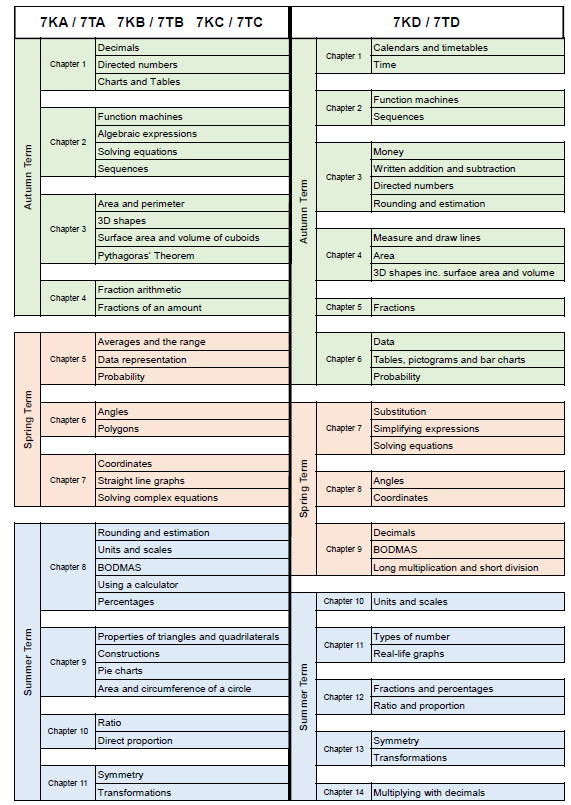
Curriculum Overview for the year
|
 |
Useful documents:
Please click here for a PDF of curriculum overview.
While this information covers a broad range of areas, please do get in touch with the Year 7 Subject Lead Miss Chappell if you have any questions.
Please click on the questions below to find out more.
How are groups organised?
The year group is split into K and T Band by the HOY. The Maths department then sort each of the two bands into ability groups. There are 4 groups in each band A to D.
The classes have six hours of Maths teaching over a fortnight and classwork and tests done over the year.
What characteristics does a successful student have in this subject?
A mathematical student will be inquisitive looking for links between different topics and how they link to other subjects. They will enjoy problem solving and always be willing to give a question a go and persevere even if it does not go right the first time.
How will students learn at this level?
Mathematics is taught using a variety of techniques including the use of calculators but also written methods. There are opportunities for students to work individually, in pairs and in small groups. Students are expected to be able to explain their methods and show workings to support their answers.
How will students’ learning be assessed at this level?
Pupils have a topic test at the end of each chapter of work, approximately every 4 weeks. Students are also set weekly homework on paper or MathsWatch.
When do key assessments take place?
They will sit a Mid-Year assessment covering chapters 1-4 in January, and an End-of-Year assessment covering all content in June.
How can parents/carers support students’ learning?
Please monitor that your child is doing homework set to the best of their ability and is being proactive when they do not understand. Use SatchelOne to find homework instructions and deadlines. When an exam is approaching often information and resources will be provided on SatchelOne, and there will always be revision booklets provided. Make sure that your child uses the booklets when revising, and checks their answers carefully. Encourage them to work on MathsWatch to look up topics they need more support or further practice on.
What equipment do students need for this subject?
- Scientific calculator – can be purchased from school
- Pair of compasses
- Protractor
- Ruler
- Pen
- Pencil
How does this subject link to other subjects?
Science and Technology: Science and Maths are intimately connected, particularly in fields such as chemistry, astronomy and physics. Students who can't master basic arithmetic skills will struggle to read scientific charts and graphs. More complex Maths such as geometry and algebra can help students solve scientific problems. Maths is also important in practical sciences, such as engineering and computer science. Students may have to solve equations when writing computer programs and figuring out algorithms.
Humanities: Humanities often require students to review charts and graphs that provide data or information. Knowledge of basic mathematical terms and formulas makes statistical information accessible.
The Arts: Musical rhythm often follows complex mathematical series, and Maths can help students learn the basic rhythms of dances used in ballet and theatre performances. Art thrives on geometry, and students who understand basic geometric formulas can craft impressive art pieces.
What websites or resources may be helpful to support students’ learning?
MathsWatch
BBC Bitesize
CorbettMaths
CGP KS3 workbooks and revision guides
What extra-curricular or enrichment opportunities are available for students in this subject at this level?
Junior Maths Challenge
HFL Education Maths Challenge
Darts Club
Sixth-form led Maths Club
What sort of careers can this subject lead to?
Business decision making. Engineering and Construction. Accountancy and other Financial services. Statistical analysis e.g. Business, Sport etc. Encryption coding. Security. Visual presentation of Data-Media services. Catering industry and a myriad of other careers
What does student work look like in this subject at this level?
Students mostly work in squared exercise books or on worksheets stuck into the books.
How does this subject support a broad and balanced curriculum, meeting the needs of all students, and developing traditional core skills?
- Maths links to multiple subject areas using a range of skills. We deal with all major concepts of maths in every term. Many of the topics are covered in real world concepts.
- The pupils are taught in ability groups within their bands. There are different resources used according to ability.
- Non-calculator techniques are emphasised throughout and mental problem solving skills are encouraged. Students are taught how to use a calculator, checking the output makes sense rather than just blindly believing the answer given.
How does this subject promote creativity, critical thinking, practice, perseverance and resilience, and making links?
- Problem solving and making links between different concepts
- We actively encourage pupils to revise for tests and exams and to always have a go at a question
- Where possible, links are made between different subject areas such as Geography and Science.
How does this subject encourage enrichment and the development of cultural capital, deep learning, and inclusivity?
- Links are made to a variety of other subjects from science, economics, music, art.
- Topics are presented in different contexts to encourage the use of different strategies and deeper understanding
- The context of questions is closely monitored and adapted if necessary